Saturday, February 27, 2016

Iqyax Update (MAE 593)

The Iqyax, from David Zimmerly's drawing of MAE-593,  is done, floats, paddles. I started this but FireFox crashed, so I probably lost some of it. Definitely lost some writing. Later.

Tentative


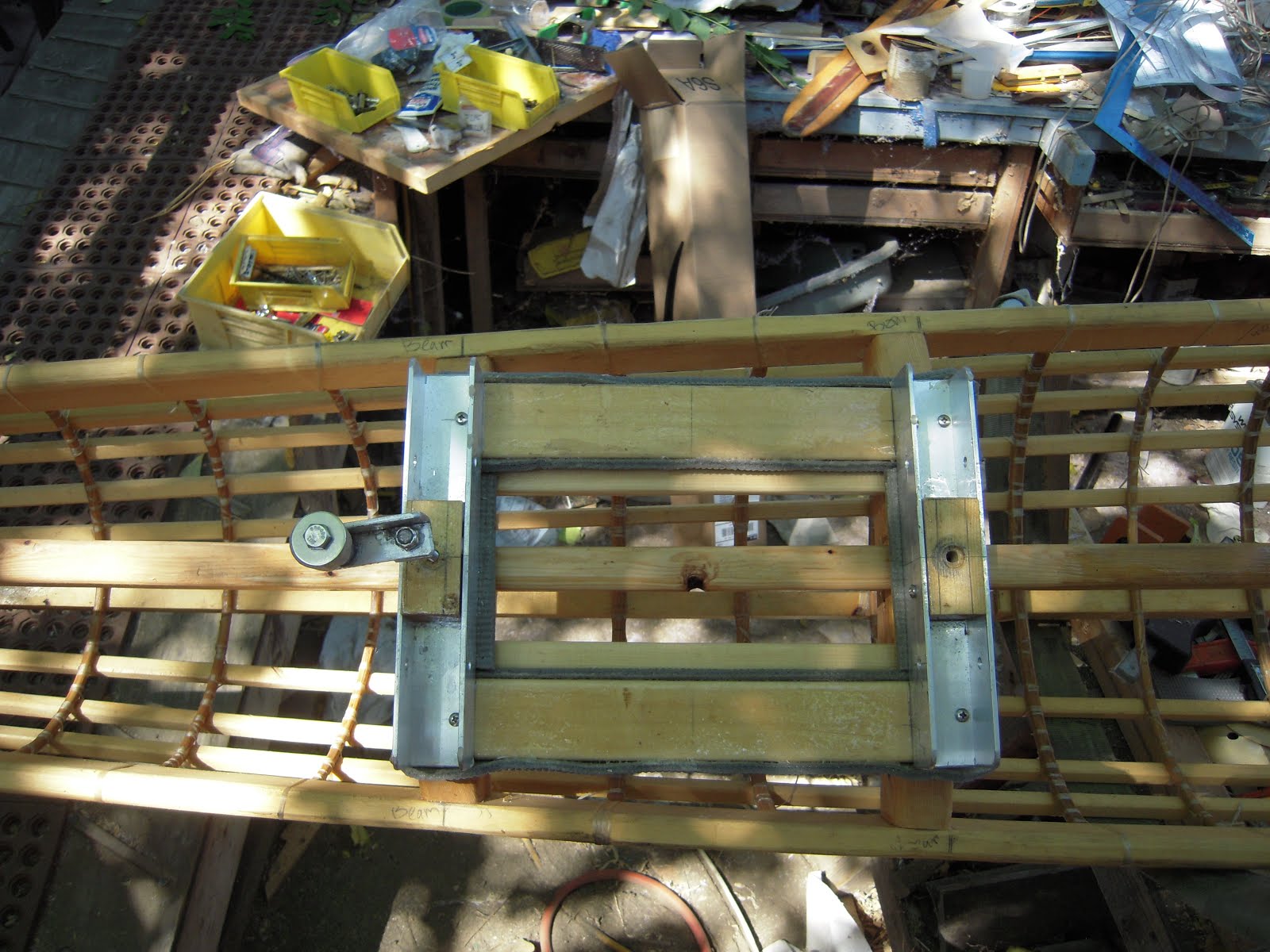
The  split bow. The piece running horizontally may not be historically correct, but it does 'fair' the line to the second stringer. The First Stringer (lowest) starts farther back. 
Aft. Should be nothing unusual here. If you look close you can see how I bolted the drain fitting to the Aft-board. See below for more info on the drain. I split and reglued the aft-board because it was warping.
The Ballistic Nylon, coating and sewing materials came from Corey Freidman of the Skinboat store and workshop. Great skin boat builder, teacher, supplier, resource. I watched his videos dozens of times. I really loved sewing the skin.  I think I used the 850 Ballistic Nylon skin. Great stuff.


My Iqyax is done, I've been paddling it.


 The coaming turned out nice, actually the second coaming turned out nice.

Without the outriggers (ama) it's too tippy.
The outriggers work great, are really lightweight and do not sit in the water all the time. Just the poles and the floats stabilize the Iqyax, instead of being jittery it's just tippy. Major change. Many kayaks could benefit from this style outrigger. You get stability, safety but very little increased drag.

I'll try to add some photos.

Alamitos Bay Beach, The outriggers, rudder parked. I can reach back and adjust the outriggers from the cockpit. I first planned to have two outrigger poles (iako) and I designed my floats (ama) for two or three. These are the third set of floats I've made. They usually just 'kiss' the water instead of ride in it. If I get going, lean to one side to plant the float, I don't turn in that direction. They are tall. I wanted the volume to be at least as much as a good paddle float so that if I need to use them for reentry I wouldn't have a problem.
NOTE: buoyancy and floats. We've all pushed a beach ball below the surface, and it popped up and smashed us in the face. Most of us have a 'common sense' understanding that the more you sink something buoyant, the more it pushes up. What is not 'common sense' or intuitive is that once a float is submerged--the push-up increase stops. Whatever force is needed to push it under is all the force needed to move it anywhere underwater. Suppose you have a float that provides 22 pounds of buoyancy, (this is 10 kg which means that it has 10 liters of volume and doesn't weigh very much, 10 liters is about 10 quarts). If you attach 22 pounds of weight to it, then it will be 'neutrally buoyant' meaning any more weight will sink it. Once something is neutrally buoyant, very little additional force will be able to make it sink to the bottom of the ocean or keep it near the surface. For an outrigger, this means that once you've submerged it--going all the way around is easy. If you need that float, it needs to be more than what you need it for.  (If this isn't clear, let me know. Might save your life.)

This is the 'pretty picture' none of the add on stuff that keeps me from drowning. Weighs about 45 pounds. As pictured without outriggers: Aleut Suicide Machine. (At some point I'll find a young paddling prodigy and let him put this fella through his paces. [Oh, you didn't know? kayaks, iqyax are male.]

I had to install a rudder. Something is amiss with the hull, the Keelson looks dead straight, but the iqyax turns in a big left circle about 100 meters in diameter. Pretty bad. I'm embarrassed to have to confess this. I use the rudder as trim, I've got two lines running to it and held in jam cleats. It's a bit cumbersome setting it, but once set I can leave it until I change direction and encounter different currents, etc...)

So far it's kind of a slow craft. I was 4.3 knots consistently in my Great Auk, 17' 23" beam. And about the same in my Mystery 20' 16" beam (but no GPS just times over the same routes). The iqyax seems to be about 3.3 knots. This is all smooth ocean, light winds. I'm not in as good a shape as I was a few years ago, but I'm not a slug, so....I also might be running the iqyax off beam through the water because of the turning problem and the rudder correction. I think I've demonstrated (but not proved) that skin boats can be as fast as solid hulls. But I'm not even close to figuring out what the Aleuts were able to do.
Below is the drain I put at the aft end on top. It's 1" PVC a threaded male fitting, bolted to the the vertical aft-board--right through the center of the fitting and nutted on the other side of the aft-board. This works really well!  I keep a few of the caps in my car. I just need to make a piano wire retaining clip, around the bolt inside and right through the center of the cap. This drains the hull really well. I'll install this on my wooden yaks when I get to it. Better than the little black one with the two screws. The rubber padding is just 1/4" yoga mat. Great stuff. I just cut a slightly smaller hole in the ballistic nylon and stretched it on to the fitting.

IOS>Settings>Restrictions>Passcode Wha ???


I had a problem with my iPhone. Somehow I had another password buried in my Settings. It caused a lot of problems, most notably it made the App Store App icon disappear keeping me from Updating any of my Apps.
There are two ways a Restrictions>Passcode is on your phone.
1. Your parents put it there to keep you from downloading expensive games from the App Store. This is not about that. or
2. You discover that  you can not get a new App or update an old App on you iPhone. Eventually you discover there's another password: known as Passcode in your settings. You have no idea how it got there. 

Apple would not allow me to post the following: (someone complained that 2014 this was still a not uncommon problem) [ added after Apple's rejection]
 

Feb 2016 IOS 9.2.1 Same problem is still going on.  Apple Care wasn't much help with Restrictions>Passcode. I finally figured out the sequence of events that leads to this mess. It's not your fault, it's not magic, it's not a bug--it's really just bad design. It's a trap.

First of all, kiddies who are trying to get around Restrictions? This doesn't apply. Your parents intentionally sought to use this to keep you out of trouble. They knew what they were doing when they setup the passcode. [psst: try grandma's birthday]
This is for the rest of us who stumbled into this: We are poking around the Settings investigating and learning. Probably those of us who uncheck the box "Please send me info every day, even better every five minutes!'
We see Restrictions. OK, what is this? We enter and we are immediately presented with a menu of stuff, and at the top it says, "Enable Restrictions" OK we're curious so we select the button and we are asked to enter a Passcode.
This key pad looks different than the one [you see] when you wake-up your phone. (I remembered it as being in a different order, like phones and calculators are different. It is not.) So you type in your PassWORD.  Mine is longer than 4 digits. This causes a problem, [but] as soon as you enter 4 digits the code is set and you go to the next step [no enter button to push, no moment of reflection]-you've just triggered the trap before you were aware something was different.   But you don't know this yet because you are looking at the lists of options that [seem like they will] should make your phone less intrusive: Push Notifications, Please Annoy Often and with strange noises, etc...  terrific. Good, [you think] I no longer want my phone to remind me in the middle of a meeting that I need to update Angry Toads...
But now [when you select some of the options for] the App Store[, it] disappears, along with the ability to update Apps when you select some of the options for it, [B]ut there is no way to know this until two weeks[, or two months] later when your Audible App stops working. You call for help, they tell you, update the app--but you can't find the App Store icon to do this..
Eventually you figure out it's this Restrictions thing and the Passcode is not your Password--You don't know what it is, because you don't remember setting it up. If it is the first four digits of your Pass[word]code you are in, and you are not reading this...
What happened to me is this turned out to be a variation of my password. I think the different key pad may be to alert you to the fact that you are now doing something different, maybe some people get it, those of us looking for help missed this too subtle tip. (I will not be a beta tester of the AppleCar. [everybody knows pressing the Home button parks the car, nobody presses the Home button when they're on the freeway....])
Apple Care told me that if I tried it 6 times and failed, it would lock my phone and I would have to Restore to New: lose information, my text messages and my mind.

This is not the case. After you fail for the 6th time, it just starts making you wait. First 1 minute. I got in on the 7th attempt, so I don't know what happens after that, but the best sources say 5 minutes, 15, 30 then 60 minutes. Some people report that they are on their 180th attempt, others that if you manually change the time on your phone you can just change the clock ahead and keep trying.

What I did. I made a list of the most likely numbers. First of all your Password, probably variations and [remember] only 4 digits--what do you sometimes mix up? If you are here reading this, you've already tried the first four digits of your password and it didn't work. Also we all have a couple of numbers we use for moderate security,  which if you are not trying to keep your kids out of trouble you might have used.
This Restrictions Passcode happens because it is one of those many areas in our digital world where as soon as you move on to the next step, you completely forget what just happened--the design of it almost guarantees this will happen. The less you know about Restrictions, the more likely you are to get in this mess.

I can tell you a number, then say 'remember it, I'll ask you for it later,'  I'll then change the subject. When I ask you five minutes later for the number you won't have a clue. It's why it's so easy to forget someone's name when you first meet.
Make the list, because as you get frustrated you will forget or doubt your accuracy. (This is why asking for a password once a week helps you remember it, but every fifteen minutes or every five minutes or every 10 seconds screws you up.) When you have your list, start working through it. If you first make a back-up to iTunes, after you get to the 30 minute waits, you can revert to the back-up. This should reset the Failed Attempts count, but I'm not sure. Restoring to a back-up, unless the Passcode is brand new, will not remove it.
I lost a full day and a lot of frustration because Apple Care scared me and I didn't want to risk that 6th attempt. I finally got through at the 7th.
This nonsense should not be happening to us 30 years into personal computing.<<end
Now is this so bad that Apple wouldn't allow me to share it with others?
Who's Big Brother now?

Saturday, June 6, 2015

Aleut Iqyax (Baidarka) (MAE 593) construction begun

I've started working towards a goal I've had ever since reading George Dyson's 1992 Scientific American article on the Aleut Baidarka. I've been building and paddling strip built kayaks for ten years now--it's time to build a skin boat.
Here's where I am as a paddler. I launch about once a week, more now that I'm on summer break, paddling the Santa Monica Bay. Conditions are usually quite calm--this ain't the Bering Sea. My current 'yak is a Guillemot Mystery with a modified deck.  This  is a very narrow racing kayak, 20 feet long about 18" beam, Swede form design.
I thought that the calm conditions of the Santa Monica Bay and my general courses being straight lines for long distances that I'd quickly get used to the minimal stability. This wasn't the case. Another critical factor, is I paddle solo. Last summer I had two incidents serious enough to cause me to carefully consider what changes I needed to make before heading back out to sea.  I added outriggers. Looks terrible, works great.
Even before I added the outriggers I don't think I gained any significant speed (over distance) than I was getting with the 17'6" (23" beam) Great Auk design. The Great Auk is a pretty fast kayak for it's dimensions, over the years, when I had a GPS, I  clocked a consistent 4.3 knots. Not doing much better with the Mystery hull is probably more about my paddling than it is about the hull. With the outriggers I'm a bit low in the stern--which is a factor. I think I have a strong consistent stroke--but I'm an old man...so....
Which leads me to building an Aleut Iqyax. I'm after speed. I'd like to learn more about how the Aleuts were so frequently observed, by reliable and trained observers (Captain Cook's navigator) at 10+ knots. These are Olympic 1000 and 2000 meter paddling speeds.
For me two issues immediately are raised. First, I wasn't able to get a racing kayak up to any significant speed, and second, I'm not good in a narrow hull. Do I build a wide Baidarka? I'm not after faking it. I don't want to build something that looks like an Iqyax, I want to build an Iqyax as close to those historically fast 'yaks as I can.
Of course I'll test what I build as built. I won't go too far out to sea.
But I'm also building a craft I can use ever week hammering out a 3 hour run. Unless the Iqyax is somehow significantly more stable than the Mystery, I'll have to (again) carefully consider stability and safety.
I intend to use a traditional paddle, wood with some buoyancy in the blades. This will help. I intend to try a very long paddle. This should give me more stability and better bracing.
But I intend to once again use outriggers. Ideally a single outrigger like a Polynesian canoe. I just don't think I know enough to be able to hang a couple of pounds off one side.
My current outriggers are supported by ~8' aluminum poles, so removing one side wouldn't be easy. Also the large turning radius of a 20' hull with no rocker is an issue.
For the Iqyax I'll need to make very lightweight outriggers, and I want to make them independently deployable, and adjustable. They will swing down, being adjustable to three positions. 1. high up, to clear the launching dock. 2. All the way down, so they just touch the water (the standard outrigger mode) and 3. just above the water, so they are more like secondary stability. In this third position I'm hoping to have the safety margin and the stability, but also be able to improve my balance through practice. If I'm balanced, the outrigger amas won't be touching the water.
After paddling for many months with the outriggers I think there's a place for them on kayaks. They add a significant safety margin. I see the day when lightweight easily deployable outriggers are an option for all kayaks. Right now with the exception of Polynesian outrigger designs, outriggers are clunky stuff, not very practical.

So what Iqyax do I want to make? Anyone who knows about this subject can probably already guess.  Two basic choices, (I've already said I go solo)  are the upturned bifid bow design in Wolfgang Brinck's book and courses, and the MAE 593 design that has the straight bifid bow--the seaweed catcher.  It's this design I want to build.
First, I think it is closer to the Iqyaxs of legend. The Russians when they invaded the Aleutians banned the super fast kayak designs. As far as I know there are no extent examples of these super fast designs. Historians and historical engineers (us), can only extrapolate backwards, squint at drawings and read and re-read accounts of these craft.

My current thinking about Iqyax design:
1. I'm bigger than they were. I'm 5'8 and 177 pounds. I might not be taller, but I'm a lot heavier.  I think the Robert Morris modified design of MAE 593 (it's longer 19'3" and slightly wider by about 5%)
2. What I understand of the flexibility is this: I think the two parts of the bifid bow could slide past each other to some degree. This may also be true at the stern. The keelson is in three parts. I think they 'hinge' at the two curved joints-but otherwise their height makes them rigid.
I think the long deck beams flexed a bit. I think the lashings on the two bow parts and possibly the stern plate are meant to be parallel so the two bow plates can slide little. The stern plate would slide against the keelson. The ribs might slide against the keelson--but I don't know enough to even speculate on this. The side to side flexibility indicated by the bow and aft cross pieces, I also don't know enough about.
I'm going to try to build it so the bow and stern can move up and down a bit, but the other movements I don't know enough to attempt anything.
(I feel confident about the two bow pieces. I think the best argument is that if these didn't move, then there's no reason not to have stitched through the gap instead of all the extra sewing required by the gap.)
3. I'm building it cheap. #3 pine. In some of the instructions for constructing a baidarka, it says to try to get the angles right, but they might not quite work. It also recommends using clear lumber so the flex and curves will match side to side. I'm an old carpenter, I know that most 2x4s aren't perfectly straight, but that the wall will be. So far what I've done proves this to be a reasonable assumption. The Aleuts didn't have lumberyards or table saws, they had to split their gunwales out of logs. Splitting and knots are incompatible. With a table saw knots aren't an issue.
4. My basic premise is that if I can build a very light, very narrow, very shallow iqyax, make an adjustable length paddle that can be from 6' to 14' long, that testing it using a gps, in the same water/wind (basically stay inside the seawall) I should be able to get some numbers indicating which paddle length, technique is close to what the Aleuts once did.


Saturday, April 18, 2015

Brief Update

I haven't done anything with my blog in quite sometime.  So here's a brief update:
1. The outriggers for my kayak. They work fine. I really need to post some photos and drawings. I think I've learned a few things that might be useful to others. I designed two outriggers, sandwiched insulating foam with plywood, cut them out, carved them and only used one layer 6 oz fiberglass. I made the crumbiest frame to connect them to my deck. Then the only thing I didn't expect happened.
It worked (almost) the first time. The only change I had to make was to extend the aluminum poles 9 inches on each side (so 18" wide hull, 3 feet 9 inches centerline deck to centerline of ama outrigger). The first time I went out my paddle was hitting the front of the outrigger floats. The extra inches completely solved that problem.

2. My DIY notebooks. I thought I loaded some images.... guess not. Well it's 1 year four months, I'm on my 5th or 6th notebook and they work great. Several months ago I made a whole stack of them. I also made some that had dots instead of lines, for technical drawing. I like them a lot.
One thing I learned is that the weight of the paper determines how heavy and how thick the notebook will be. I use standard inkjet, laser, 20 lbs paper. Anything thinner becomes hard to find, but also becomes a bleed through problem--unless it's coated. My notebooks are 100 sheets, 200 pages and I fill them up. I found plastic folders at Office Depot that I cut away a bit of the pocket flaps near the fold, my notebooks slip right in. I haven't been able to find any nice leather holders that would work as well, also no other folder except these Office Depot ones work.
Again, I need to post some photos.

3. Still thinking of new ideas. Recently reading about Gustave Whitehead, a Connecticut, inventor who clearly didn't invent the airplane before the Wright Brothers. Looking at photos and a reproduction of this best model, and also thinking about Langley, it's very clear that no one really had any idea of what an airplane should look like before the Wrights. Lillienthal's gliders worked and seem to be the model for most of the wings used by everyone prior to the Wrights, but I wonder if Whitehead and Langely really had much understanding. Lillienthal's wings seem structured like those in Leonardo's drawings, umbrellas, etc...
It doesn't surprise me that after the Wright Brothers Langley and others showed that pre-Wright designs could also fly. Sure, and  Kelly Johnson and Lockheed's Skunk Works proved they could fly anything.
So I'm not trying to harangue Langley and Whitehead, what I want to say is that the next thing that will fly, or travel through water, is not going to look like an airplane. The Wright Brothers copied Lillienthal, then they took it all apart and began testing every element of what they understood. They made more gliders and then in 1903 they made a plane that actually flew, but was so flawed it was almost uncontrollable. They soon improved on this, and lots of other people improved on it.
Only in the past couple of months have I found anyone on the net asking the question I've been asking, What's the slowest speed something can fly?
What I'm really asking is, what does the flying vehicle that uses the least amount of energy, look like?
We have two ways of looking at this. The Kestral high performance sailplane and ground effect wings.
Well, more later.

Saturday, May 24, 2014

Ama for a kayak

May 24, 2014
I’ve been poking around the internet looking for information on amas, aka outrigger (usually 1 on one side.)
Here’s what I understand so far:
1. Amas on one side of an outrigger have two basic functions. 1. to provide supportive buoyancy when the ama enters the water. When  the canoe leans on that side, the ama keeps it from tipping or rolling over. 2. The second function of an ama is to provide a counterbalance to tipping on the side that doesn’t have an ama. A theoretical ama that has no mass would work in one direction only.
I’ve seen some discussion of adding weight to amas but nothing conclusive.

An ama in the water should be designed so as not to create significant drag that would slow down the canoe or cause it to turn. Outrigger canoes with amas can be longer and narrower even longer and narrower than surf skis. Outrigger canoes are usually about 25% faster than kayaks.

The outrigger ‘arms’ that hold the ama are usually one fore and one aft of the paddler. I’ve seen mention of single arm amas, but none that seem practical. There’s a lot of leverage on an ama.
My concern about placement of the arms is I still want to use a double bladed kayak paddle which is used differently than are the single blade outrigger paddle.

A typical kayak paddle float is 3” x 18” x 8” (NRS), displaces about .25 cubic feet, or more useful: 7.07 liters so it has a buoyancy of 7.07 liters (minus the weight of the float...which is minimal).
This is a special temporary outrigger device. If you remember practicing with a paddle float you should remember doing it a bit wrong, submerging the float. Once a float is submerged, the upward force does not increase, so a firmly attached float that is submerged can travel 180 degrees.
This is the submarine problem. Inventors would add more and more ballast until they reach neutral buoyancy, once neutral buoyancy is reached, the submerged object could sink or rise to just about any level in the water. Water being incompressible makes a submarine different from a lighter than air balloon which does reach a level based on buoyancy, pressure, etc.. and then will tend to stay there.
What used to happen to early submarine experimenters is that once submerged the vessel would just sink right to the bottom. Modern subs tweak buoyancy and have dive planes. If a sub reaches  particular depth, if it levels off, it looses its up and down momentum and so is better able to keep a particular depth.  I don’t claim expertise on this. My point is that once an outrigger or paddle float is submerged its usefulness is severely diminished.

Where we get this wrong (usually when we are about 15 years old and male) is when we try to push a ball down into the water. It seems to get harder and harder so we gain a false understanding that pushing it deeper will be even harder. It isn’t. Before we find this out, the ball has slipped through our hands popped out of the water and smashed us in the face. We are then reluctant to repeat the experiment.

All of this is why many discussions of amas say that an ama should be able to support the displacement of the whole craft (the weight)
Do not design and paddle an ama based on this article, it is far from complete. Frankly, I’m surprised how all the information on this subject seems so disconnected. This is a result of three factors. 1. An ama means many different things, I get sites that discuss 60 foot trimarans, and 23 foot outriggers and hollowed out traditional Polynesian craft. 2. The web seems to be fragmenting, where the challenge used to be finding the right terms to query, increasingly what comes up in google is uniformed discussion, chitchat, a discussion among experts or one that started a long time ago. (More and more problems I have with my Apple computer that I search for solutions instead brings up complete and utter nonsense. Apparently fewer and fewer people who actually know anything post in Apple’s Support blogs. (I can’t figure which Apple password to use, so I stopped bothering. See my comments about wireless Magic Mouse batteries above).

Why am I posting this? First of all, why I’ve been thinking about amas: I have a 20’ kayak that is 18” wide that I’ve found to be a bit too tippy. I like paddling solo, miles off the coast, so this vessel seems too dangerous. (No complaints) If I can add an ama, I get to tinker (which I enjoy) and I should wind up with a hybrid (bastard) kayak that is even more stable than my wider 23” kayak. It’s worth giving it a go.
The reason I’m posting this is that I considered making a very small ama that would keep me from rolling. This would work but not in the range of situations it should or I might assume it would.
I am still not sure of how much buoyancy I need. I do intend to make one, make it using foam (if there’s a breach a foam filled ama will still float, a waterlogged one won’t).

Amas also work another way. The design and the angle of the keel make their first effect like that of a kayak paddle brace. They skim the water providing enough upward force to stop the roll.
Another facet of this idea is that amas become increasingly buoyant the deeper they are submerged. This doesn’t contradict what I’ve written above. As more volume of the ama is submerged more water is displaced, so more buoyancy is achieved.
A well designed ama should provide enough ‘skim’ to minimize the drag of a hull moving through the water. It should be long, often 3/4 the length of the outrigger canoe. Hull speed applies here--long and narrow is a more efficient hull than short and wide. Finally they are tall so they progressively submerge only to the depth needed to proved the amount of buoyant force needed for the particular situation.
Finally, if submerged or nearly submerged,  they should be able to buoyantly support the entire weight of the craft and the paddler. This keeps the canoe from rolling completely over. In catamarans, especially racing boats, this allows them to ride up on one hull without it sinking in and rolling over.

I’ll add updates when I have some results.

Note: I apologize for not posting more photographs, videos, drawings, etc…. This is inexcusable for a professional photographer. My only excuse is that no one seems to be reading, or even to have noticed, this blog. So, I guess it doesn’t matter.

Tuesday, March 18, 2014

DIY Perfect binding Notebooks

I filled up my first DIY notebook. On March 1, I started using my second DIY notebook. I just love these notebooks. I made the lines fainter, by making them thinner and dotted. I also added a copyright line--but don't let that stop you from making one for yourself.

Something about them suits me just right. They're cheap, have plenty of room (200 pages 35 lines each); that and my new cheap Pilot Plumix calligraphy pen. Look them up. A $12 fountain pen with a calligraphy nib,  Down strokes are wide, side strokes are narrow. It's not like making wedding invitations. I just wanted to try the nib out, it's cheap enough, and I don't think Pilot can make a scratchy fountain pen nib. I wasn't wrong.

What I like is that the calligraphy nib seems to make my writing a little neater and easier to read (maybe--I might be wrong, typing up my writing seems kind of slow). And when I recently looked at some of Charles Dickens' writing, he cut his feather pen to a similar nib. Now at last I can write like Charles Dickens even if I'm a long way from writing like Charles Dickens.

I'm also sure his fingers were as ink smudged as mine. Before you stop using cartridges and just fill up the barrel with Bulletproof (permanent) Noodler's--make sure you've filled any holes and use an O-ring.

If anyone is at all interested... I'll be happy to post some images, post a 200 page blank document of just page numbers.... and possibly a video on how to make one of these notebooks. Happy to share.

It's March 18 and I'm 80 pages into the new notebook. There is a fetishistic aspect to writing. A new pen, a new notebook, some little thing and a writer writes. Consider I've spent my afternoon writing on a computer. I'm either busy or just don't know when to shut up. I'll do that now.

Next Generation Science Stardards grumbling....

I'm doing a weekend Professional Development series of courses to learn how to create lessons using the Next Generation Science Standards (NGSS). I'm always a little grumpy with anything like this. It's part of my process. I get annoyed, and then I say I'm not going to let this beat me, so I dig in and work harder until I get results. What I would (cynically) say my method really is is this:
1. We're given some set of theories, requirements, whatever....
2. As I learn about them I see the shortcomings, flaws, nonsense....
but because I'm supposed to come up with something. . . .
3. I figure out how to make something good out of it, I translate what I've learned and what's been proven to work into something that fits the catch-phrases of the set of theories....
Everybody should be happy.
I make lessons, and then students stare at their cell phones, eat Cheetos (they buy in the official school student store, all day long) and 11th graders sit and do nothing until asked about it then they say, "I don't have a pencil."
Bottom line: No theory, new school reform, iPad, or giving away pencils is going to teach anything to any student who isn't committed to learning and who is allowed to attend school to stare at a cell phone, eat junk food in class, sleep....

(I figure with this blog posting I could be fired, so let it all hang out.)
I've been in a lot of schools. There are schools where students are not allowed to cuss at anyone, have their cell phones out, etc... these students are happy and learning. Nearby there are other schools, same demographics (I am arguing that these are district and school failures, nothing else) where no one is allowed to go any farther than to ask politely (they can F-bomb you back- with ZERO repercussions) to put the phone away. If they don't, too bad. These students are not happy and many if not most students in these schools are not learning much of anything.

 Critique Number One. This was an e-mail, that I would never send: There's no point, it wouldn't be understood.

Is there anywhere examples of actual lessons designed using the NGSS methods that we are currently working with? When I look online for lessons  based on the ‘new thing’ the ‘big reform,’ including NGSS and Common Core, what I find is a lot of chatter about what it will do, how it will do it—it’s endless, but no lessons.
I have to conclude that this is all basically a shell game. Clicking on links within the NGSS site results in endless circles all saying the same things, and leading right back to the pages I started on.
Links exist to connect, links that run in a circle are by nature useless and false. They appear to do something, but if they just lead in a circle, they are doing nothing.  Rhetorical tautologies prove nothing, lead nowhere. In education the trick is not to run around the same tree but to run around three trees before you are sent back to run around the first tree. (Wikipedia: Consequently, the statement conveys no useful information regardless of its length or complexity making it unfalsifiable. It is a way of formulating a description such that it masquerades as an explanation when the real reason for the phenomena cannot be independently derived.) 

As I fill out the forms we are given to design our NGSS lessons and units, they don’t seem helpful so much as simply busy work. I’m at the stage with one lesson where I’ve got a lot of blank spaces that have three basic purposes:
1. to re-apply the old cliches, “The 5 E’s”,
2. to do my actual lesson planning and
3. I don’t knows. I’m not sure what should go in these.
The lesson planning boxes seem to require what lesson plans have always required: What will I do, what will students do, what resources do they need, and what will success look like. The rest just seems like window dressing. It’s like last year when they gave us all 150 page books on teaching English and the only real change is they changed a half dozen acronyms.
(There should be a 4th item. The important things in NGSS that there seems to be no slot in the form to place them.) 
I know I’m missing something. The people who make these things are not evil, malicious or clueless. Still I can never get past the feeling someone is putting something over on me.
(During my teacher training we were told to use a website to design our lessons, we were carefully instructed on the basics, with a promise that the website did so much more…. This was 8 years ago. I was so annoyed with how poorly it worked, taking forever to do anything, frequently crashing, that I designed a FileMaker Pro database to do the same thing. Took me less than an hour. I made another data base, loaded in all the relevant science standards. After a couple of hours this ‘amazing tool’ that probably cost a lot of money, was superseded. Even if you’ve never made a database, you could learn how in about two hours and then in another two hours…..
We are repeatedly being oversold on the completely unremarkable.

I do like the basic ideas behind Common Core and NGSS, deeper thinking, working collaboratively, organizing learning not around a list of facts but around broader concepts and ideas. The execution however is overly complicated, recursive and vague. I wouldn’t mind this so much, if it weren’t such a hassle to work with. (We’re supposed to enter the information from the book or website into our lesson planning documents. The website and the pdf versions don’t copy and paste very well. A single paragraph takes up a whole page, sometimes it’s (well here’s an example:
HS (Hard Return)-(Hard Return) ESS2(Hard Return)-(Hard Return)2.(Hard Return) Analyze…. (text is also broken up, but not as badly)
This is just one of the items
HS-ESS2-2. Analyze Geoscience data to make the claim that one change to Earth’s surface can create feedbacks that cause changes to other Earth systems.”
This item by the way is different from “ESS2.A Earth Materials and Systems”
Can you see how difficult this can be to work with?
 I burned out. Mostly I write this stuff, bury in a journal, that in turn is buried on my hard drive, and I move on. It’s easy to take this stuff apart, but it’s also a waste of time.


I did send this the National Association of Science Teachers web page that is about a book:
What I've seen in the 40 page pdf preview of Translating the NGSS, this is simply more of the same 'talking about' but nothing  concrete and applicable, like an actual lesson plan, or unit plan.  The NGSS materials I've been given has a whole book that endlessly repeats the same theory and concepts multiple times. Another book, another PD, powerpoint, etc.... that 'talks about' is of no use to anyone.  I'd like to see an actual set of lesson plans, unit and course plan, that could actually be taught. 
There's some good in the NGSS, but it seems everyone connected to it is burying it in chatter. 
End of this message.

No one else has commented on the book, so I doubt anyone has read the page, or if they have they’ve just shrugged and moved on.

How I like to design a lesson:
I like to use empirical examples of lessons actual teachers use with real students. Any of us can look at ten examples of something and then be able to begin creating our own. Orson Welles and his creative group watched Stagecoach, a western 42 times and then went on to make Citizen Kane--definitely not a western.
The other way I work is to think about how I learned something, or how a body of knowledge and skills are organized and then build up from there. It’s a fun process and I’ve come up with some good presentations and good projects.

(I won’t claim to be anything like a great teacher. I think my instructional design is top notch, but in the classroom….? I think I do well with students already willing to learn. Those against learning, I don’t seem to have convinced.)  I have the chutzpah to write and post this stuff because 1. no one seems to have noticed my blog so it’s harmless, so far and 2. I have made great stuff, helped students make great stuff. I’ll post some of the water rockets, hot air balloons, my right hand rule of Earth in space, and much more…

 I was on a roll. Why get hanged for one sheep when I could get hanged for two? So I posted this:
California Science Teachers Association (CSTA) website.  CSTA was good enough to let me teach a few workshops at their annual conventions.

The last item on the list of NGSS implementation is "development of curriculum materials, assessment development." No where is there mention of teaching students.

How long are we going to continue doing this in education (and going along with it)? If what you propose is possible, practical and better--clearly discussing theory and teaching theory to teachers before anyone makes a single lesson is backwards. It hasn't succeeded in the past, isn't likely to succeed now or ever. With the sole exception of Quantum Physics, theory has always followed practical implementation. Always. (See Nassim Nicholas Taleb, I think Antifragile, though it might be in Fooled by Randomness.) 
The alternative is 1500 years of Aristotelian theory of gravity while the obvious reality was ignored. 
If a great science teacher taught a group of students and those students learned a lot, made great imaginative projects and amazing labs; and these results were compared with a committee generated pile of theory, 'awareness phase,' 'focus groups' yada-yada-yada with absolutely no implementation; the committee stuff would prevail.

Why? Because that is the way we continue to do things. Obviously there's great science education out there, but we spend endless amounts of time, effort, money with this well meaning overly complicated stuff.  There's a lot in NGSS that I like; the implementation so far is so bizarrely overcomplicated I'm wondering if this isn't an elaborate ruse. It’s more a very weird puzzle than a set of instructions.

I would like to suggest that no one be allowed to spend another minute of teachers’ time until they’ve taught real students with real lessons and documented the results. It’s not like it’s hard to find students who wouldn’t benefit from more learning experiences. 

I'm curious, is this just cranky nonsense? Or are a lot of us annoyed by how this is being done? 
End (I’ve tweaked it a bit here and there, but left enough grammatical mistakes to keep it’s sense of …. ranting).
OK. Now all I have to do is wait….to be fired. 

What absolutely amazes me is how we go along with this stuff. I am really interested in finding out if I’m just a crank. This is either the emperor’s new clothes, or I’m just a grumpy old man. 
I think Richard Feynman would agree with me; clearly I’m following his lead. I also think that my science knowledge, ability to learn new things and apply them to lessons, extend my learning into new areas, create original and unique inventions; supports my position as a legitimate source of criticism. What also seems to be the case is that people in education management and ‘team players,’ disagree. 

I think these things keep happening this way because we are all intimidated into believing that these committees, consultants, ‘experts’ know more than we do. I don’t think they do, in fact I don’t think they know much of anything. What they do know is how to work the system, network and promote themselves. No one in education gets very far being clearly more intelligent then his or her boss. An important part of becoming a teacher is sitting in endless meetings pretending to be interested in shear nonsense.

What more do I need to do to make my case?
One thing would be to share some of my teaching here. I’ll post some of my projects soon. One of our soda bottle rockets was recently clocked at 178 mph.